Friday, June 19, 2015

3 Well-Intended Recruitment Strategies That Sabotage Nonprofit Boards

There are many reasons nonprofit organizations should engage in ongoing and active recruitment of new board members; however, there are two reasons that tend to drive the recruitment strategies of most, especially small and newly formed organizations: The bylaws require a minimum number of board members, and the board is responsible for ensuring the nonprofit has adequate financial sources.


Nonprofits that focus on filling seats and filling the bank instead of identifying board prospects with a passion for (or at least a genuine interest in) its mission and purpose, use well-intended recruitment strategies that ultimately sabotage the board. Here are a few strategies that though they may be well-intended, do more harm than good to a nonprofit board and its organization:

Who’s Who Recruiting

In every community, there are people whose names open doors. And getting those people on your board isn’t a bad thing. However, their names alone won’t be enough to meet all of the responsibilities of a board member. So like everyone else, recruiting of these people should have less to do with their name and influence and more to do with their passion for or interest in your cause. If not, you will likely find their commitment is limited to allowing you to put their name on your marketing materials and making an occasional call on behalf of the organization.

Serving on a nonprofit board requires just that --- service. If you are going to recruit a “Who’s Who” to your board, ensure that they are fully committed to serve. During the recruitment process, provide the prospect with a copy of the bylaws and a copy the board member position description which outlines all of their responsibilities. Review these with the prospect and ensure that they agree to meet all of the outlined responsibilities before voting them onto your board.

I Can Twist His Arm

In board recruitment, “no” means NO! In developing your board prospect list, there will be individuals you feel would make an invaluable addition to your board. It may be because they have a skillset your board desperately needs, their passion for your cause, their influence, or their capacity to give significant financial support. Whatever the reason, you want them! But when asked, they say no. What should you do?

Some nonprofits take the twist their arm approach. This is particularly the case where the prospect is a friend or close acquaintance of the person doing the recruiting. They keep asking and asking and asking until the prospect finally says yes. But what kind of board service can you expect from someone whose arm had to be twisted? In most cases, the minimum is their maximum.  If a board prospect says no, respect their decision. Offer them other ways to get involved, such as volunteering on a committee. Getting them involved in a way that requires less commitment could increase their passion for your cause and result in a more committed board member in the future.

Term Limits-Shmerm Limits!

One of my biggest pet peeve when it comes to nonprofit boards is the lack of term limits or the lack of enforcement. Term limits (and there should be limits) are there to ensure a nonprofit’s leadership remains fresh, energized and committed to the nonprofit’s mission and purpose. Board service requires a commitment of time and resources. When it comes to time commitments, members attend board meetings, committee meetings, events and other activities. When it comes to resources, board members commit to both making personal donations and soliciting and securing gifts from others. And if every member of the board isn’t serving at the same level, those that give the most in their time, talent and resources can easily burnout.

Additionally, a lot can change in someone’s life over a few years. For example, life experience can change one’s passions and interests. Term limits are designed to prevent board members who have burned out or whose interests have changed from feeling obligated to continue on the board. And yet it happens. I’ve had the experience of attempting to secure a gift from a board member whose service had continued without interruption for 45 years! Naturally, when asked to give, he informed me that he and his wife focused their philanthropic activities on supporting cancer research. Life experience had changed their passion and interests. Despite having the capacity to give thousands of dollars, he gave me a check for $100.

No matter how tempting it is to ignore them, enforce your board’s term limits. Allow board members the opportunity to recharge their battery and return in the future, or to serve an organization whose mission better matches their new passions and interests.

Keep doing good and creating opportunities for people to do good with you!

Michelle Nusum-Smith, an experienced nonprofit leader, consultant, coach and trainer, is a self-proclaimed “Do-gooder who helps do-gooders to do good.” Michelle is the owner and principal consultant at The Word Woman LLC, a nonprofit consulting company. She has nearly 20 years nonprofit experience, including program development, financial management, fundraising (including grantwriting and individual donor cultivation), human resource management, marketing and public relations, board relations, and event planning.


www.thewordwomanllc.com • info@thewordwomanllc.com • 240-215-4984

Monday, June 8, 2015

Four Steps towards Starting a Nonprofit

When thinking of starting a nonprofit, there is a fundamental question you must answer and answer correctly? That question is why?


“Why do I want to start a nonprofit?”


A nonprofit organization is a business, just like a for-profit; however, a nonprofit is formed for the purpose of fulfilling a mission to improve the common good of society rather than to acquire and distribute profits.

For a nonprofit to launch, grow and be sustainable until it achieves its mission; the founder must put the cause before him or herself. Can you honestly say, “It’s not about me.”?  

If you said yes, you are ready! So, let’s get started!


1.    CAUSE: What idea, cause, issue or concern has you thinking of starting a nonprofit? (Example: Children who don’t qualify for free lunch go hungry because their parents can’t afford to pay the daily reduced rate.)

___________________________________________________________________
______________________________________________________________________________________________________________________________________
2.    MISSION STATEMENT: What would your nonprofit aim to do to address your cause? (Example: To ensure no child misses lunch at school because of their inability to pay.)

___________________________________________________________________
______________________________________________________________________________________________________________________________________
3.    VISION STATEMENT: What would happen if you achieve your mission? (Example: Hunger-free schools where each child is well-nourished and prepared to learn.)

___________________________________________________________________
______________________________________________________________________________________________________________________________________
4.    BOARD DEVELOPMENT: Who will support your vision?
Having the right people on your Board of Directors is critically important to not only the launch of your nonprofit but also to its long-term sustainability and overall impact. Now that you have the first draft of your Vision Statement, you can begin reaching out to prospective board members. These are people who will share in and support your vision. You should have one-on-one discussions with people who offer skills or expertise your nonprofit needs to achieve its goals. These people will need to agree to give of their TIME (attend meetings), TALENT (volunteer their expertise and skills), and TREASURE (donate generously to your cause). Though you will want to recruit at least five board members, you’ll need to reach out to at least twice as many prospects. List below the names of ten people who might support your cause by serving as a board member. Among those your recruit should be a lawyer, accountant, and someone who directly or indirectly will benefit from your nonprofit. In the example above, you might recruit the parent of a child who misses lunch because the family budget is limited.

NAME
ROLE/EXPERTISE
BEYOND ROLE/EXPERTISE,
WHY THIS PERSON?
1)     

Beneficiary Representative

2)     

Lawyer

3)     

Accountant

4)     


5)     


6)     


7)     


8)     


9)     


10)  


Congratulations, you are four steps closer to starting a nonprofit! Are you ready to take the next step? The Word Woman LLC can show you how. Contact us at info@thewordwomanllc.com to schedule a complimentary 60 minute-consultation.   


Keeping doing good!

Saturday, June 6, 2015

The Chicken Little Approach to Fundraising

Most of us have someone in our life who it seems only calls when they need something, and that something is most often money. After a few of these calls, just the sight of their number on our caller ID makes us both anxious and annoyed.

Ever roll your eyes and ask, "What does he want now?" even before you answer?
And even though you hope things will be different whenever he calls, Chicken Little always immediately jumps right into describing his latest crisis and how much money he needs in order to get out of it. At the end of his monologue, you are faced with a decision -- do you help him out one more time or do you say no and hope it all works out for him.
If you say yes, you might be left feeling used, unappreciated, and regretful -- especially because you know he'll be calling you to get him out of the next crisis. If you say no, you might be left feeling guilty -- especially if the "life and death" situation turns out to be real and not an exaggeration.
I think we can all agree that as an acquaintance, a friend and even as a family member, no one likes to be treated like an ATM. The same is true of donors. Nonprofits must protect their donors from fundraising (even in times of crisis) that might leave them rolling their eyes and asking "What do they want now?" 
Cultivate genuine relationships with donors by keeping them engaged and communicating with them not only during fundraising campaigns but throughout the year. Below are some examples of ways to cultivate genuine relationships with prospective and current donors:
  • Call to make an introduction and gather information about the donor and their interest in your organization.
  • Meet a donor for coffee/lunch to gather information about the donor and their interest in your organization and share updates on your progress.
  • Maintain an up to date mailing list and regularly (but not too often) communicate with donors through e-mail, e-news and direct mail.
  • Invite donors to your events (not just the fundraisers) and other activities, as appropriate.
Always update donors on your organization's progress, particularly the programs the donors has supported. And if there is a crisis and a donor provides support, be sure to report back to the donor sooner than later what happened and express again and again your sincere gratitude for their support.
Keep doing good and creating opportunities for people to do good with you!
Michelle Nusum-Smith, an experienced nonprofit leader, consultant, coach and trainer, is a self-proclaimed “Do-gooder who helps do-gooders to do good.” Michelle is the owner and principal consultant at The Word Woman LLC, a nonprofit consulting company. She has nearly 20 years nonprofit experience, including program development, financial management, fundraising (including grantwriting and individual donor cultivation), human resource management, marketing and public relations, board relations, and event planning.
www.thewordwomanllc.com • info@thewordwomanllc.com • 240-215-4984

Thursday, April 16, 2015

8 Simple Ways to Make Volunteers Feel Appreciated

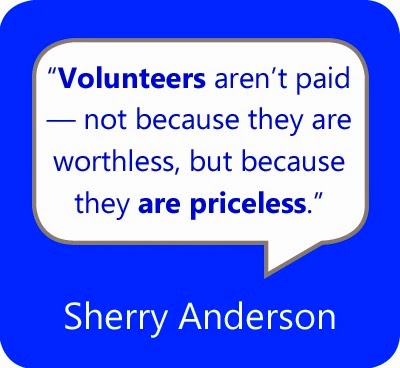
No matter the size, every nonprofit needs volunteers to operate and to achieve its mission. From the people that serve on the board and those who support special events to those who serve in an ongoing capacity, EVERY volunteer is invaluable. But does every volunteer feel invaluable? Unfortunately, the answer is no. Of course, there isn't a single nonprofit that doesn't recognize how invaluable their volunteers are yet many still fail to make their volunteers feel appreciated.

So, in honor of National Volunteer Week (April 12-18, 2015), here are 8 simple ways to make your volunteers feel appreciated:
  1. Give each volunteer a written position description with clearly defined duties and responsibilities as well as the time commitment.
  2. Assign a contact person to each volunteer and give the contact a copy of the volunteer’s position description. Give the volunteer a written copy of their contact’s information and instructions on when and how to appropriately make contact. If possible, have a backup contact.
  3. Provide volunteers with ongoing opportunities to ask questions and gain clarity.
  4. Provide ongoing opportunities and encourage volunteers to provide feedback.
  5. Sincerely and personally say “Thank you”.
  6. Privately and publically acknowledge each volunteer’s contribution.
  7. Provide each volunteer with a token of appreciation, such as a certificate and/or small gift.
  8. Host a fun, social volunteer-centered event that includes activities suggested by your volunteers.
Keep doing good and creating opportunities for people to do good with you!

Michelle Nusum-Smith, an experienced nonprofit leader, consultant, coach and trainer, is a self-proclaimed “Do-gooder who helps do-gooders to do good.” Michelle is the owner and principal consultant at The Word Woman LLC, a nonprofit consulting company. She has nearly 20 years nonprofit experience, including program development, financial management, fundraising (including grantwriting and individual donor cultivation), human resource management, marketing and public relations, board relations, and event planning.

www.thewordwomanllc.com • info@thewordwomanllc.com • 240-215-4984

Wednesday, December 31, 2014

Is Your Nonprofit CLOSED?

I have worked directly for, partnered with, consulted, and supported as volunteer and/or donor countless nonprofit organizations over nearly twenty years. They have varied in size, scope and cause. And just because an organization was large or had been around for decades didn't mean it was “open for success”. For a nonprofit to be successful toward achieving its mission, it must take down the proverbial CLOSED sign. Here are a few traits of a closed nonprofit and tips on how to open for success:

Resists Partnerships. Being a large organization or one that has had much success toward achieving its mission may not see any benefit to partnering, particularly with smaller shops. The organization likely has a decent reputation among the general public (and funders) so it doesn't see the need for partners. Though partnerships may be needed or necessary, partnerships should also be about opportunities. Partners provide new perspective, new energy and new relationships. Additionally, most funders prefer to support collaborative efforts. Organizations open for success are open to formal and informal partnerships.

Avoids Change. There is nothing wrong with dedicated staff whose passion for the cause has resulted in tenure that has lasted years or even decades, but what happens if longtime staff is not encouraged (or better yet required) to engage in ongoing professional development? They become complacent. Their creativity diminishes and eventually ingenuity becomes a dirty word. This is typically a top down issue in nonprofits. An organization that is closed to new ideas and innovation likely has a board of directors comprised of the same set of people who have been on the board for years or decades (I've seen this!). Organizations open for success have and enforce board term limits. Identifying and securing new, highly-skilled, passionate board members is an ongoing effort. These organizations encourage new ideas from board members and staff, invest in staff training, and require staff to not only attend conferences but to seize opportunities to present!

Lacks Diversity. While countless studies prove the benefits of diversity in the workforce and service and advocacy for groups historically discriminated against is the mission of many nonprofits, far too many organizations have little or no diversity among their staff and board. Workplace diversity refers to the variety of differences between people in an organization and goes far beyond race. It encompasses race as well as gender, ethnicity, age, personality, tenure, education, background and more. I have visited the websites of numerous organizations where pictures of the staff are included with their bios. All of the staff are the same color, about the same age, and have the same socio-economic and educational backgrounds. In addressing an issue or opportunity, can a group of “clones” offer a variety of perspectives and solutions? Can true debate exist among people who look alike, talk alike, and think alike? Organizations open for success are intentional about diversity. They strive for a staff that creates a diverse collection of skills, experiences and perspectives. They recognize that the more they reflect the world around them the better equip they are to serve it.

Michelle Nusum-Smith, an experienced nonprofit leader, consultant, coach and trainer, is a self-proclaimed “Do-gooder who helps do-gooders to do good.” Michelle is the owner and principal consultant at The Word Woman LLC, a nonprofit consulting company. She has nearly 20 years nonprofit experience, including program development, financial management, fundraising (including grantwriting and individual donor cultivation), human resource management, marketing and public relations, board relations, and event planning.


www.thewordwomanllc.com • info@thewordwomanllc.com • 240-215-4984